

U of A physician-scientist sets the record straight on kissing bugs
A spate of bad press involving the insects resulted in scary headlines, but years of Stephen A. Klotz’s research show they pose little risk.

Stephen A. Klotz, MD, has spent decades studying kissing bugs to make sure the public has the facts about the insects, which sparked concern earlier this fall.
Photo by Noelle Haro-Gomez, U of A Health Sciences Office of Communications
Ah, kissing bugs.
Don’t be fooled by the cute name. They feed on blood, freak people out and periodically whip the internet into a frenzy. In fact, that happened this fall when some researchers lobbied to label kissing bug disease – also known as Chagas disease – endemic in the United States, spiking public concern.
This is nothing new to Stephen A. Klotz, MD. He’s seen kissing bugs blow up the news cycle time and time again, especially in Arizona. In fact, he and his team used to trek to Bisbee, where you could watch kissing bugs walk the streets.
Klotz, a professor in the Department of Medicine and Department of Family and Community Medicine at the University of Arizona College of Medicine – Tucson, studies infectious disease and estimates he’s written 30 to 40 papers on kissing bugs, which live throughout North, Central and South America. In the United States, they’re mostly found in Arizona, as well as California and Texas.
“It’s an endless fascination for humans,” said Klotz, who was chief of the U of A Division of Infectious Diseases from 2008 to 2016.
Despite panic-inducing headlines that refer to Chagas disease as a “silent killer creeping into U.S. homes” and declare it is on the rise, Klotz said decades spent studying the disease’s epidemiology and how it’s acquired show there is little to worry about.
“It’s not a big problem,” he said.
Klotz would know.
Catching the bug
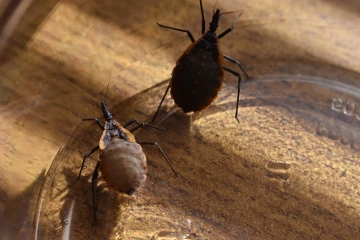
Kissing bugs typically are black with orange markings and about the size of a penny. Triatomine bugs got their nickname for their tendency to bite people in the face.
David Mogollon, U of A College of Medicine – Tucson Department of Medicine
Klotz joined the University of Arizona in 2000, drawn to the institute’s infectious disease researchers and their mutual interest in studying fungi. It was actually Klotz’s younger brother, an epidemiologist at the University of California, Riverside, who piqued his interest in triatomine bugs, aka kissing bugs.
“He wanted some drawings of kissing bugs, which I didn't know much about,” Klotz said. “So, I provided pen-and-ink drawings. Over the years, we probably published 20 or 30 papers together on different insects.”
Slightly bigger than a penny and mostly black with orange markings, the kissing bug nickname comes from its tendency to bite people in the face. The bites are so innocuous that they usually go unnoticed. The concern lies in the fact that about half of the bugs carry a parasite, Trypanosoma cruzi, that causes Chagas disease.
If you’ve ever donated blood, you might recognize Chagas disease from one of the screening questions. It’s potentially deadly and can result in heart damage. But for the most part, people who are infected with the disease are symptom-free. The disease also can affect animals.
“It’s been endemic in animals for centuries here, and it’s found in wild animals like opossums and raccoons,” said Klotz, who added that in the Southwest kissing bugs feed on pack rats.
Here’s where it gets ugly – and unlikely – for humans to get infected, and you may want to put down that bowl of Cheerios before reading further. To get infected with Chagas, the kissing bug must not only bite but then quickly poop in the wound before leaving a body.
“The species in our area are very reluctant to defecate,” Klotz said. “The likelihood of being infected is very small. For someone to feel an itch at the bite and rub something into the wound is thought to occur maybe once every several thousand bites.”
Of greater concern, Klotz said, is people developing anaphylaxis from getting bitten so many times that they become allergic to kissing bugs. In fact, kissing bug bites are the most common cause of insect bite-related severe allergic reactions in the United States. At one time, Klotz was developing an immune therapy for people who were getting bitten repeatedly. He even enlisted the help of an entomologist near Phoenix.
“He used a device he invented that gave the bug a shock so he could collect the venom or saliva,” Klotz said.
The problem was, he had a hard time collecting enough saliva because it was difficult to keep cultures alive.

Stephen A. Klotz, MD, studies infectious disease and has written dozens of papers specifically on kissing bugs, which have been reported in 32 states.
David Mogollon, U of A College of Medicine – Tucson Department of Medicine
“We’d have hundreds, thousands of eggs, and they hatch very quickly,” Klotz explained. “Then you’ve got to feed these little characters, and they’re so small in that first stage of life that they can get lost in the hair shafts of the animals that you’re feeding them with. You’ve got to be careful. You don’t want them in your carpet.”
Arming people with knowledge
Klotz initially had different critters in mind when he graduated from high school in eastern Kansas. He planned to study veterinary medicine at Colorado State University. Instead, he followed his gastroenterologist father into medicine.
These days, Klotz spends much of his time providing a telemedicine clinic for the Arizona Department of Corrections. He offers regular webinars and a course on Chagas for second-year medical students. He continues to educate, hoping that if and when scary headlines pop up, people will have enough knowledge to “let them put it into context with their lives.”
Klotz assumes he’s been the victim of a kissing bug bite, although he never noticed.
So, what should you do if you see a kissing bug? Don’t touch it. Don’t hesitate to call in pest control experts if you suspect a problem in your house. Most of all, Klotz said, keep the bugs in perspective.
After all, he pointed out, “It’s not as bad as living with rattlesnakes.”