

Implementing Safety Measures for Return to Campus
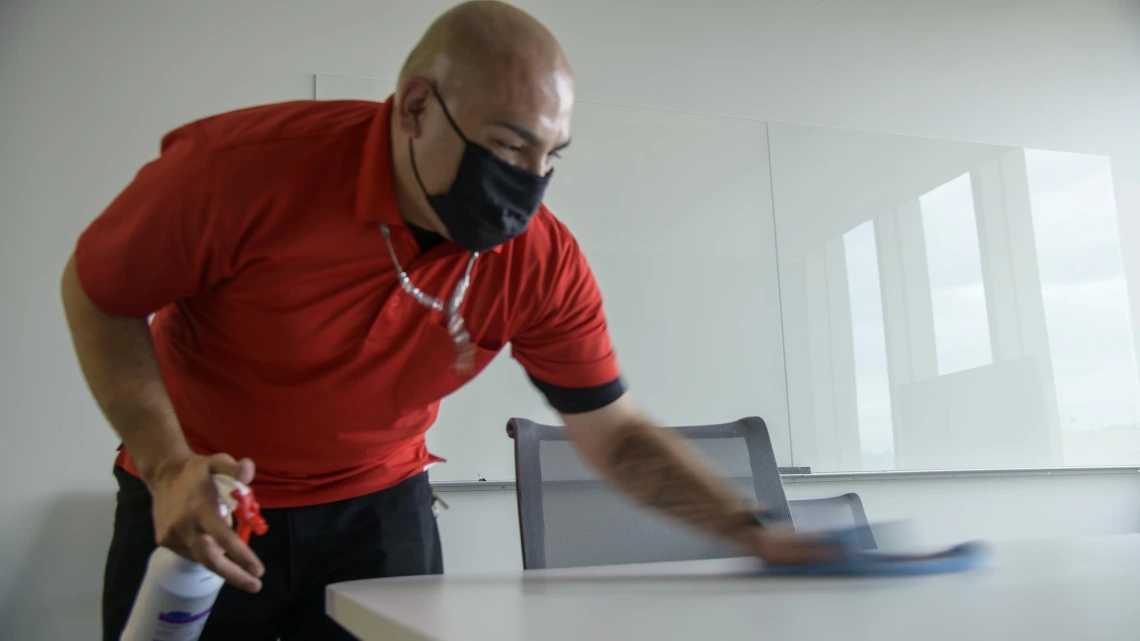
Jose Benitez from University of Arizona Facilities Management cleans a table in the Health Sciences Innovation Building.
In response to the pandemic, University of Arizona risk management, planning and facilities teams have implemented public health measures across campus, including Health Sciences buildings. As students, faculty and staff return, they'll notice many changes, including hand sanitizer installed at entrances; plexiglass barriers at desk areas; signage with reminders about masks and social distancing; hands-free restroom fixtures; sufficiently spaced furniture; room and elevator capacity limits that facilitate safe physical distancing; and an abundance of cleaning spray in every classroom.

College of Medicine – Tucson students enter the Health Sciences Innovation Building.

Across campus, signage reminds passersby to follow CDC safety guidelines for mitigating the transmission of diseases such as COVID-19.

Signage reminding passersby to follow CDC safety guidelines.

Alexandra Almli from University of Arizona Facilities Management cleans a door at the Mel and Enid Zuckerman College of Public Health before placing new signage.

Signage outside of the UArizona Medical Bookstore encourages students to follow proper safety precautions.

Signage reminds Wildcats to follow safety precautions. Bear Down!

A thermometer is available for faculty, students and staff for temperature check at the Center for Innovation in Brain Science at Bioscience Research Laboratories. The center implemented COVID-19 screening with daily online health surveys and temperature scans for all faculty, staff and students entering buildings.

Graduate student Gregory Branigan receives a temperature check outside of the Center for Innovation in Brain Science at Bioscience Research Laboratories. The center implemented COVID-19 screening with daily online health surveys and temperature scans for all faculty, staff and students entering buildings.

Paola Limon from University of Arizona Facilities Management brings disinfectant and paper towels to classrooms.

First year College of Medicine – Tucson student Yasi Suri, left, puts sanitizer on his hands before he and fellow first year student Jonathan Yasmeh head to a class in the Health Science Innovation Building.

First-year College of Medicine – Tucson student Andria Albert sanitizes her hands before entering the Health Sciences Innovation Building.

First year College of Medicine – Tucson student Charles Andrew Jauregui checks into Daily Wellness Screening on his laptop before heading to a class. The wellness checks must be completed using the Wildcat WellCheck screening tool, which allows employees and students to self-screen for symptoms before they arrive on campus.

First year College of Medicine – Tucson student Charles Andrew Jauregui checks into Daily Wellness Screening on his laptop before heading to a class. The wellness checks must be completed using the Wildcat WellCheck screening tool, which allows employees and students to self-screen for symptoms.

In a large lecture hall, a plastic barrier has been installed to reduce the spread of aerosolized droplets that could carry viruses and other bugs.

Mary Matthews (left) and Angie Souza (right) of Health Sciences Planning and Facilities measure the distance between desks in a Drachman Hall classroom to ensure students stay six feet apart.

Across campus, cleaning products are ubiquitous.

Jose Benitez from University of Arizona Facilities Management cleans a table in the Health Sciences Innovation Building.

Newly installed plastic barriers protect staff and visitors in a reception area in Drachman Hall. From left: Ali Bridges, College of Pharmacy director of communication, and administrative assistant Amy Dorgan.

On the eighth floor of the Health Sciences Innovation Building, medical students work with standardized patients to learn how to interact with people seeking medical care in a clinical setting.

Medical students have a sense of humor.

Mary Matthews (left) and Angie Souza (right) of Health Sciences Planning and Facilities measure the distance between chairs in a student lounge in the Health Science Innovation Building to ensure that the placement of furniture facilitates adequate physical distancing.

The lounge area in front of the Arizona Health Sciences Library has been slightly reconfigured so that furniture facilitates physical distancing between people.

George Fantry, MD, senior associate dean in the College of Medicine – Tucson points to new signage to help people keep appropriate distance.

Conference rooms fit fewer people to allow for adequate physical distancing. Here, incoming first-year College of Medicine – Tucson students meet with their house dean, George Fantry, MD.

Signage reminds people to maintain appropriate physical distancing in elevators.

Decals placed on elevator floors mark six feet, helping visualize appropriate distance.

First-year College of Medicine – Tucson students Aileen Lee (left), and Brianne Davis (right) stand on signs placed on elevator floors marking six feet.

Angie Souza (left) and Jill Garcia (right) of Health Sciences Planning and Facilities measure the distance between desks in the Health Sciences Innovation Building to calculate new seating requirements, ensuring people stay six feet apart.

Classrooms now have fewer chairs to help students maintain physical distance of six feet.

This map shows where all new signage will be placed around the Mel and Enid Zuckerman College of Public Health in preparation for the return of students.

Chris Skertic of University of Arizona Facilities Management helps hang new signage that will remind visitors to wear masks and maintain appropriate physical distance.

Signage on the College of Pharmacy study room reminds students of the limited occupancy.

Signage reminds passersby to follow the CDC guidelines.